If you are working on how to remove ink stains from fabric, use blot fresh ink with a clean white cloth and do not rub. Check the care instructions before adding water, solvent or stain remover. On fixed upholstery, use only a fabric-approved treatment and test it out of sight first. Stop if the ink spreads or the upholstery changes.
What should you do as soon as ink gets on fabric?
Fresh ink is usually easier to manage. Press a clean white cloth or plain kitchen towel onto the mark and keep moving to a clean section as ink transfers.
Do not scrub or immediately add water. Rubbing can spread the mark, while excess liquid can enlarge it or create a ring on fixed upholstery.
Remove the leaking pen or any wet object from the sofa before it transfers more ink.
How to remove ink stains from fabric upholstery
Use this approach for a small ink mark on fixed fabric upholstery.
- Blot wet ink. Use a clean white cloth with light pressure, changing to a clean section as colour transfers.
- Read the care label. W generally allows water-based cleaning, S solvent-based cleaning, W/S either, and X vacuuming or specialist care only.
- Identify the fabric. Velvet, viscose-rich upholstery, natural fibres and standard synthetics can react differently.
- Choose a fabric-approved ink treatment. Do not assume a household cleaner is suitable because it dissolves ink elsewhere.
- Patch-test it. Let the hidden test area dry and check for colour loss, stiffness, residue or texture change.
- Treat only the mark. Use minimal product and blot rather than scrub.
- Remove residue only as directed. Do not automatically rinse fixed upholstery with water.
- Let it dry fully. Stop if the stain spreads, a ring appears or the surface changes.
Professional ink-spotting guidance from Prochem also stresses pre-testing, avoiding over-application and blotting rather than rubbing. Its ink product is labelled for professional and industrial use only.
Fresh biro, permanent marker and dried ink are not the same problem
Fresh biro may still transfer onto a white cloth when blotted. Dried, permanent-marker and unknown ink can be less predictable and may need specialist spotting.
If a mark is large, old or already treated with several products, avoid another experiment. Some ink staining can become permanent, especially after previous treatment, heat or colour damage.
Should you use rubbing alcohol, hairspray or nail polish remover?
Do not treat rubbing alcohol, hairspray, hand sanitiser or nail polish remover as universal sofa remedies. Their formulas can affect dyes, fibres, finishes or leave residue.
Use the sofa manufacturer’s guidance and a stain treatment approved for the fabric. If solvent treatment is required and you are unsure what is suitable, stop rather than improvising. Never mix cleaning products.
Washable fabric and fixed sofa upholstery need different treatment
Washable clothing or a genuinely machine-washable cover can often be rinsed or laundered after treatment. Follow its care label and avoid tumble-dryer heat until you have checked the stain.
Fixed upholstery is different because excess liquid can reach foam or padding and leave a wider ring. A zip does not prove a sofa cover is machine washable.
Stop DIY treatment if you notice these warning signs
Further cleaning is more likely to cause damage when:
- ink is spreading beyond the original mark
- colour is transferring from the upholstery itself
- the fabric is becoming lighter, darker or stiff
- a water ring is forming
- the pile or texture is changing
- the material is velvet, suede, viscose-rich or unidentified
- the care code is S or X and you do not have an approved method
- several previous stain removers have already been used
At that point, record what has already been applied and avoid adding another product.
When professional ink stain removal is worth considering
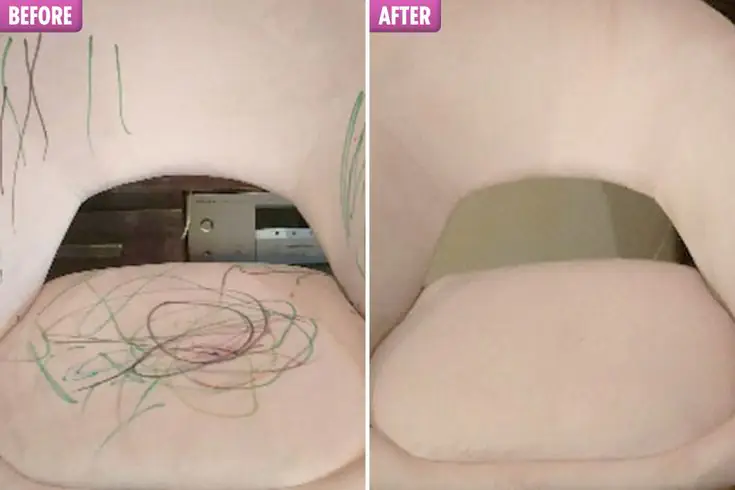
Professional treatment is worth considering when ink is large, dried, on delicate upholstery or has resisted one suitable attempt.
A cleaner can assess the fabric, ink and previous treatments before choosing a method. For sofas, see our professional sofa cleaning. For other soft furnishings, check out the upholstery cleaning service.
Complete removal cannot be guaranteed. Our sofa cleaning cost guide explains the main factors that affect professional pricing.
Frequently Asked Questions
1. Can dried ink be removed from fabric?
Sometimes. Dried ink is generally harder to treat than a fresh mark, and the result depends on the ink, fabric and previous products. Avoid repeated rubbing or several solvents. Use an approved treatment or seek advice for delicate upholstery.
2. Can I use rubbing alcohol on a fabric sofa?
Only if the manufacturer or an appropriate upholstery product allows it. Alcohol can affect dyes, finishes and fibres. Patch-test first, and do not improvise on S or X coded upholstery.
3. Does hairspray remove biro from upholstery?
Some hairsprays contain alcohol, but formulas can also contain oils, conditioners and fragrances. Results are unpredictable on upholstery, so a fabric-approved stain remover is a more controlled choice.
4. Should I use hot water on an ink stain?
Do not default to hot water. Some sofa fabrics should not be wet-cleaned at all. Follow the care label and the instructions for the approved stain treatment.
5. What if the ink stain gets bigger while I am cleaning it?
Stop. The ink may be moving beyond the original area or too much liquid may be in use. Blot excess moisture if appropriate, let the area dry and reassess.
Give the stain one careful treatment, not five experiments
The best approach on how to remove ink stains from fabric is controlled rather than aggressive: use blot fresh ink, identify the fabric, follow the care label, test the right treatment and stop if the mark or upholstery changes.
If an ink mark is large, old or on a fabric you cannot identify, you can find a sofa cleaner near you and ask for the upholstery and previous treatment history to be assessed before more cleaning is attempted.